
Hart County Projected Versus Actual Release
A projected release date estimates when a sentence may reach a release or completion point under the facts then in the correctional record. It can reflect the judgment, credited prior confinement, earned credit, sentence structure, and applicable release law. An actual release date records the completed event after the jail or DOC processes the person out. These dates can differ.
For a Hart County pretrial detainee, there may be no projected sentence date at all. Release can turn on bond, recognizance, dismissal, a court order, a plea, another hold, or case disposition. A county-sentenced person may have a local calculation maintained by the Hart County Jailer. A state prisoner’s information belongs in Kentucky DOC systems. The live Hart County jail portal is a current-custody source, not a historical release-date archive.
The completed Hart County admission/release entry or DOC discharge record is the best proof of the actual date and authority. A court order explains the legal basis but may precede processing at the facility.
Find a Hart County Projected Date
Start by identifying the custodian. This avoids searching Kentucky DOC records for a person whose only custody was a local pretrial stay. It also prevents a transfer from Hart County Jail to a prison from being called community release. Use reliable identifiers, since names alone can produce the wrong offender record.
- Decide whether the person is a local detainee, county-sentenced person, or Kentucky DOC offender.
- For a state offender, open Kentucky Online Offender Lookup, or KOOL. Begin with last name and first initial, then add identifiers as needed.
- Use a DOC or PID number when known. For a date-range search, use the exact advanced field “Projected Release Date From / To.”
- Open the matching detail record and read location, status, sentence, parole eligibility, projected date, and supervision information together.
- For a local detainee or county sentence, call the Hart County Jailer at 270-524-2571 and ask which existing calculation or record can be provided.
- Check the Hart County court case for the judgment, bond order, jail-time credit, sentence change, or release order.
- Confirm an actual exit through the jail admission/release record or a DOC discharge record.
The Hart County release search and records route provides the broader fallback chain. KOOL should be used for a person who entered DOC custody or supervision, not as a complete archive of Hart County Jail bookings.
Hart County Dates in KOOL
KOOL’s exact advanced-filter label is “Projected Release Date From / To.” It finds records within a calculated interval. It is not an “actual released on” field. KOOL can also show a Parole Eligibility Date. That date marks when review may occur under the governing rules, not when a person must be released.
The interface includes DOC and PID numbers, Supervision Status, Location Type, Location, County of Supervision, institution or supervision start dates, offense and conviction filters, and escape or abscond date ranges. Read the record as a whole. A location at Hart County Jail indicates a present DOC association with that jail. It is not a released result. A community-supervision location may show that imprisonment ended while a DOC obligation continued.
KOOL’s FAQ says updates occur four times daily, while the landing material describes daily entries and accuracy work. It warns that data newer than 120 days may not be final. Frequent refreshes do not make the system minute-by-minute proof. For former-offender information unavailable online, DOC directs requests to Offender Information Services, P.O. Box 2400, Frankfort, KY 40602-2400.
Kentucky Credits Affect Hart County Dates
KRS 197.045 governs several Kentucky sentence-credit mechanisms. Current law includes qualifying prior-confinement credit. It also provides 90 days for an approved diploma, degree, or technical program and up to 90 days for approved drug-treatment, evidence-based, promising-practice, or life-skills programming. Discretionary good-conduct credit can reach ten days per month, while exceptional meritorious or emergency-service credit can reach seven days per month.
Those figures are not a calculator to apply outside the official record. Credits other than qualifying prior confinement may be forfeited or denied for institutional violations. Sex-offender-treatment restrictions and other conditions can apply. Consecutive sentences are merged for credit computation under the statute. The DOC calculation must account for the judgment, eligibility, credit awards, losses, and sentence structure.
- Prior-custody credit
- Legally recognized time spent confined before the present sentence calculation.
- Good-conduct credit
- Discretionary credit tied to conduct under Kentucky law and DOC rules.
- Program credit
- Credit tied to completion of qualifying education, treatment, or approved programming.
- Forfeiture
- Loss or denial of applicable credit after an institutional violation.
For a Hart County county sentence, ask the Jailer for the maintained calculation and completed discharge record. State-prison credit belongs to DOC. A court docket may show jail-time credit or a corrected judgment but does not replace DOC’s full administrative calculation.
Hart County Violent-Offender Date Limits
KRS 439.3401 is Kentucky’s violent-offender provision. For covered offenders serving a term of years, current law can bar probation, shock probation, parole, conditional discharge, or other early release before 85 percent of the sentence. Current language also limits credit so it cannot reduce the sentence below the applicable floor, while preserving qualifying prior-custody credit specified by law.
The 85-percent figure must not be applied just because a charge or conviction sounds violent. The statutory definition, offense date, sentence terms, and version of the law must fit. Life sentences and capital provisions differ. An accurate Hart County answer therefore starts with the actual judgment and controlling statute, not an informal offense label.
Even a correctly computed minimum does not provide the gate time. Another warrant, detainer, court action, or processing step may affect where the person goes when one sentence reaches its release point.
Parole Dates for Hart County Offenders
KRS 439.340 and 501 KAR 1:030 govern parole authority and eligibility calculations. The regulation provides review schedules and exclusions. One current rule provides first review for a qualifying nonviolent Class D felony aggregate sentence of one to five years after 15 percent or two months, whichever is longer.
Review eligibility is not a parole grant. A favorable Board action is not the physical discharge timestamp. The schedule may show that a hearing is planned, and the Board action may state Recommended, Deferred, or Serve Out. The DOC release evidence still determines whether and when the person left prison. If released under parole to Hart County, District 5 supervision can continue after incarceration ends.
The successful manifest image comes from the official parole eligibility regulation.
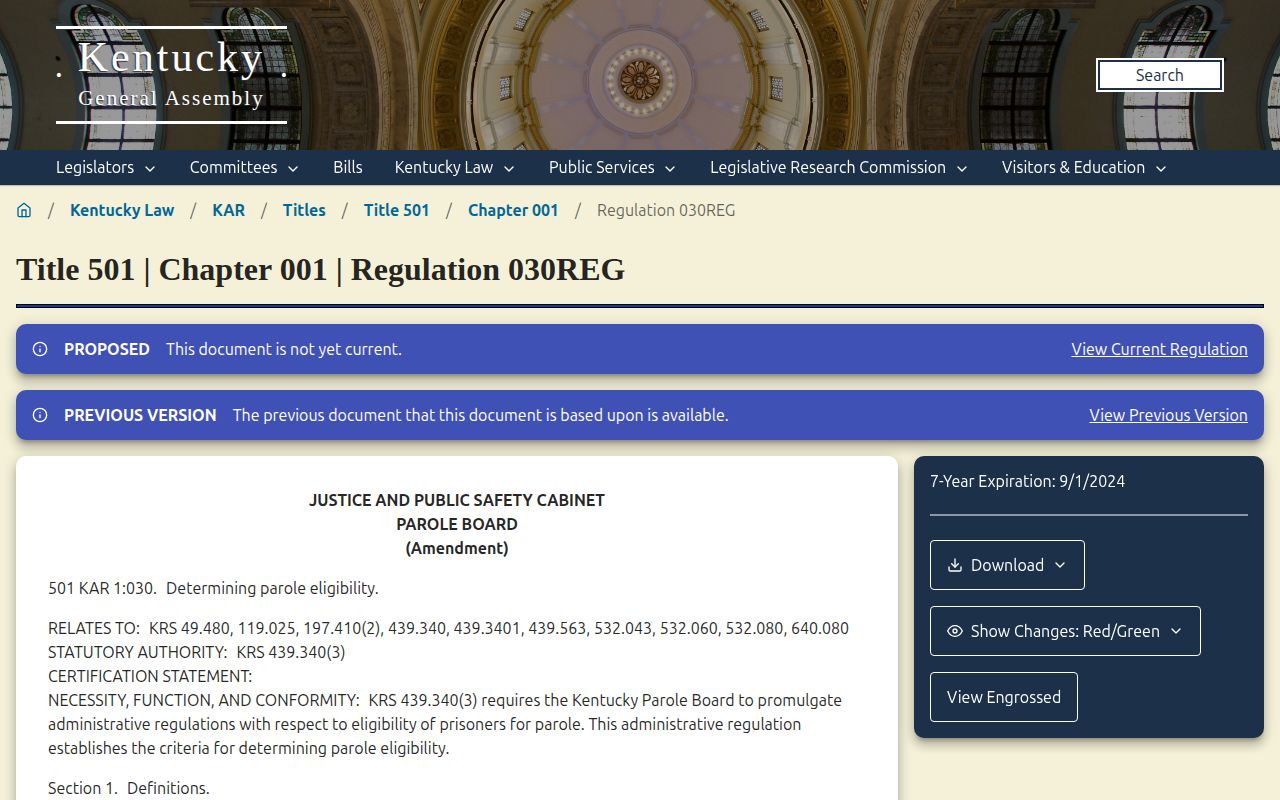
The regulation supplies review rules, but the person’s own judgment, DOC calculation, and final discharge evidence control the individual result.
Hart County Mandatory Reentry Timing
KRS 439.3406 adds another distinction to a projected date. For an eligible inmate not granted discretionary parole, mandatory reentry supervision generally begins six months before projected sentence completion, subject to statutory exceptions and conditions. Time while absconding does not count as the statute requires.
This status can place a person in the community under DOC supervision before the projected completion of the sentence. It is not a discretionary parole grant, and it is not the end of every correctional obligation. KOOL may show supervision fields after the prison location changes. Hart County falls within Kentucky DOC Probation and Parole District 5 for state supervision.
The distinction answers a common date puzzle. A person can be outside prison before the projected sentence-completion date because the form of custody changed to mandatory supervision. The DOC record, not a guess based on the listed date, identifies that status.
Why Hart County Release Dates Change
A projection uses the information available at the time of calculation. Later credit decisions, corrected judgments, Board actions, and outside holds can change it. Some factors change the computed endpoint. Others leave the sentence date intact but prevent community release or delay physical processing.
| Factor | Effect on projected or actual release |
|---|---|
| Prior-custody credit | Can reduce remaining time when legally credited |
| Good-conduct or program credit | Can move projected completion earlier when earned and applicable |
| Credit forfeiture or denial | Can move a projection later |
| Corrected judgment | Can move the calculation in either direction |
| Concurrent or consecutive terms | Changes the aggregate sentence calculation |
| Violent-offender rule | Can impose an 85-percent floor in a covered case |
| Parole action | May permit conditional release, defer review, or leave imprisonment in place |
| Mandatory reentry supervision | May begin supervised community status before projected completion |
| Warrant or detainer | Can prevent community release when one sentence ends |
| Institutional processing | Can make actual exit later than an order or calculation |
A detainer is a request by another authority to hold or transfer the person. It can mean departure from Hart County Jail without release to the community. Ask for the discharge disposition and receiving authority so the event is described correctly.
Do Hart Pretrial Detainees Have Dates?
Often they do not. Kentucky KOOL offers a precise projected-date range for state offender records, but many Hart County pretrial detainees have no sentence from which to compute one. Their release depends on bond, a court order, dismissal, case disposition, and any other holds. Searching a KOOL date range for such a person can therefore fail even when the person is properly held at the county jail.
Call the Hart County Jailer for current custody and the existing local record. Check the Hart County court docket for bond changes or a release order. If a person leaves the live roster, request the actual discharge date, time, authority, release type, and any transfer destination. That record separates completed community release from movement to DOC or another custodian.
Confirm a Hart County Release Date
Register through Kentucky VINELink when advance notice is useful. VINE can report custody changes and a release date, but it is a notification system rather than the signed discharge order. For Hart County Jail, confirm with the Jailer’s admission/release entry. For a state prisoner, confirm with DOC discharge evidence. For probation or parole, verify the separate supervision record.
Keep the person’s full name, date of birth when appropriate, booking or DOC number, facility, and approximate dates together. Ask for an existing record instead of asking an office to research a broad narrative. The actual discharge field is the endpoint that turns a projection into a documented event.
Note: A release from one custodian does not rule out transfer, a detainer, or supervised community status.
Public Record Search
Sponsored Results